Nb2O5 is one of the popular high-index materials used in optical thin film coating in the Visible, NIR and SWIR regions. It is an alternative to absorbing TiO2 or expensive Ta2O5 for most of the applications.
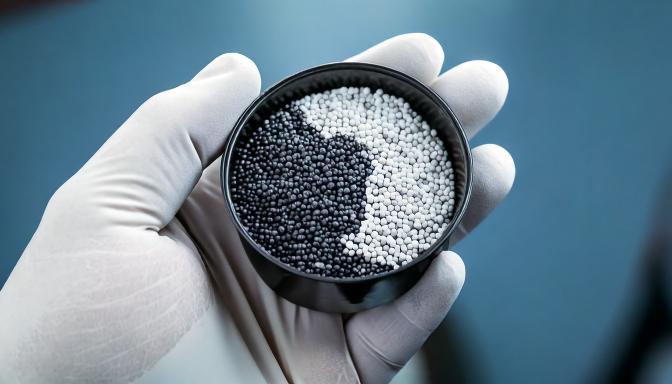
There are white and black granules on the market. White ones are fully oxidized, pure nb2O5, and black ones are lower oxidation states, sub-stoichiometric ones. When you use white granules, if you watch chamber pressure during the melting or evaporation stage, you will see it will outgass more than reduced black granules. Because when you apply energy to melt it using your e-gun, the material will reduce and outgass oxygen. Since white ones are fully oxidized, it will outgass more. This is also the answer to using oxygen plasma during the evaporation of oxide materials. You give their lost oxygen during evaporation back while it is growing on the substrate.
So which one should you prefer? Well, both will work, no problem. I personally like to work with reduced materials because it does not outgass a lot and I regulate chamber pressure easily to keep my ion source or plasma source stable from beginning to end. It is also easier to melt black ones; however, there is a chance to reduce it towards the metal state if you apply excessive energy during melting. Also, you will drill a hole in the material inside your crucible for long processes if you use Nb2O5 a lot. If you want to go with white ones, it will outgas more, but it will melt homogeneously inside your crucible during the process, and you can be sure about the stoichiometry of your material all the time.
Nb2O5 is a stable material when you evaporate with plasma or ion assistance in your application. It needs around 100 eV energy from your plasma source for densification, and you can achieve this 100 V (ideal)-130 V (max) bias using an APS source. If you increase the bias and energy, it will add compressive stress to your thin film. MK2 ion source with a discharge voltage of 130-150 V should be ideal. If you use an RF plasma source, typically you can regulate the chamber pressure around somewhere between 2.0 and 2.5 E-4 mbar, and it should be enough energy and ion current density. You can fine-tune oxygen partial pressure depending on your source, but the material itself is pretty stable and won’t be affected much by excessive oxygen pressure. You may try to add/increase Argon gas to your source to improve densification.
If you have any questions, please do not hesitate to comment under this post or contact me. I am always up to expanding the topic.
Hello,
I’m Oğulcan

Welcome to my blog! I am one of those engineers who loves writing about everything. I share my memories, paintings, travels, and experiences here!
Let’s connect
Join the fun!
Write your email to subscribe:



 Oğulcan Açıkgöz
Yorum bırakın